Syntex and Large Language Models
Syntex and Large Language Models: A Particularly Attractive Combination
Syntex is one of the tools Microsoft is using to make significant strides in artificial intelligence (AI), especially since the breakthrough of its chatbot ChatGPT. The company offers a wide range of applications and tools powered by AI, OpenAI, and Large Language Models (LLMs). Syntex is integrated into the Office 365 Cloud, allowing you to perform all kinds of smart operations on documents without having to write any software code.
For organizations in the legal sector, such as law firms, this makes for a particularly attractive combination. Over the years, these organizations often accumulate hundreds of thousands of stored documents, frequently without anyone or any system retaining a complete overview of what is located where. The average lawyer is not a software expert, and specialized software talent is becoming increasingly scarce and expensive, making an accessible and user-friendly solution like Syntex an ideal answer.
A Role for AI: Classification and Extraction
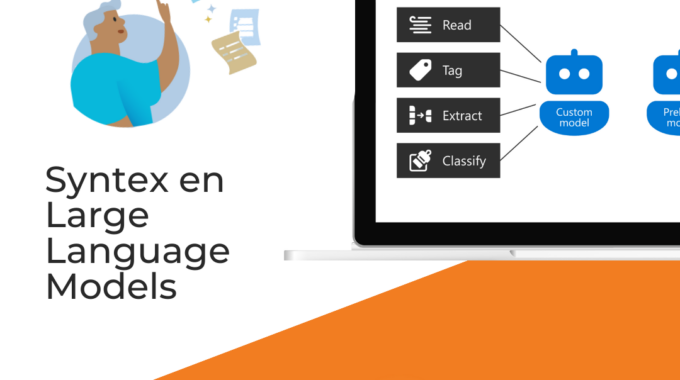
For a company like Documentaal, whose client base is largely within the legal industry, Syntex is definitely worth putting to the test. Let us look at a realistic scenario: from a library of several hundred scanned PDF documents stored in your SharePoint environment, we want to extract the contracts originating from one specific organization. From those contracts, we want to identify the signatory or signatories. In Syntex terminology, this process is known as classification and extraction.
Depending on the specific requirements and IT experience within the organization, getting Syntex fully operational can require an investment of time. Hiring external expertise for this might be an attractive option. However, once it is up and running properly, Syntex can also be maintained by non-IT professionals. That is a major advantage over custom-built solutions.
In terms of classification, Syntex performs quite well: in our test set, eleven out of the twelve tested documents were classified correctly.
When it comes to extraction, performance was lower: only three out of twelve signatories were correctly recognized. The underlying algorithm turns out to be very sensitive to optical interference, such as a smudge on the scanner glass or a signature overlapping the printed text. Unfortunately, many people have a habit of signing exactly like that. As a result, Syntex's performance in this test fell short.
Regarding turnaround time, Syntex took anywhere from a few minutes up to half an hour, depending on server traffic. For a small number of documents, that is rather long, but the upside is that this processing time barely increases for larger volumes. You can therefore process an entire SharePoint environment in a very reasonable timeframe.
Classification and Extraction via Python, OpenAI, and LLMs
In a previous blog, we described how ChatGPT by OpenAI can be used to unlock domain-specific knowledge. In short: you provide selected domain knowledge alongside your prompt, and OpenAI typically returns a very acceptable answer. At the same time, this shares your knowledge—in this case, your document—with OpenAI, which is not always desirable. This is why Microsoft launched its own version of OpenAI a few months ago. Everything you send there remains strictly within your own Microsoft environment and is not shared with the outside world.
It is interesting to investigate whether we can achieve the same results with this approach as with Syntex: reliable classification and extraction. It requires a bit of trial and error to phrase the prompts so that the answers are genuinely useful, but the results prove to be surprisingly good: out of twelve documents, all twelve were classified correctly, and ten signatories were correctly identified. Python is also somewhat affected by optical interference, but to a far lesser extent: 10 out of 12 instead of 3 out of 12. Python requires around 10–20 seconds per document, which does add up for larger volumes.
In summary: if your organization only needs to classify documents, Syntex is a solid choice, especially for high volumes. If extraction is needed and optical interference is present, Python currently performs better. However, it is expected that Syntex's character recognition will improve soon. Syntex also has the advantage of requiring no coding on your part, making the tool significantly more user-friendly.
What Can Documentaal Do for You?
Documentaal has decades of experience with document management systems and is fully versed in the latest technologies in AI and Large Language Models. Would your organization benefit from expert guidance in unlocking large volumes of documents? Please feel free to contact us! Our experts are eager to apply their knowledge to help you gain even better insights into all the information stored across your organization.


Get in touch now
Do you have any questions about our products and/or services?
Feel free to contact us directly.

AI and the three biggest benefits for document creation and management
Artificial intelligence (AI) is a game-changer in knowledge-intensive sectors such as legal and accountancy. AI offers…